Guides
Client onboarding vs. offboarding for a virtual assistant agency: a 2027 checklist
A 2027 checklist for virtual assistant agencies covering onboarding files, access revocation, final retainer reconciliation, exit surveys, and the referral loop.
What to take away
- Onboarding and offboarding are the same client file read in two directions. Capture access, scope, and billing details on day one.
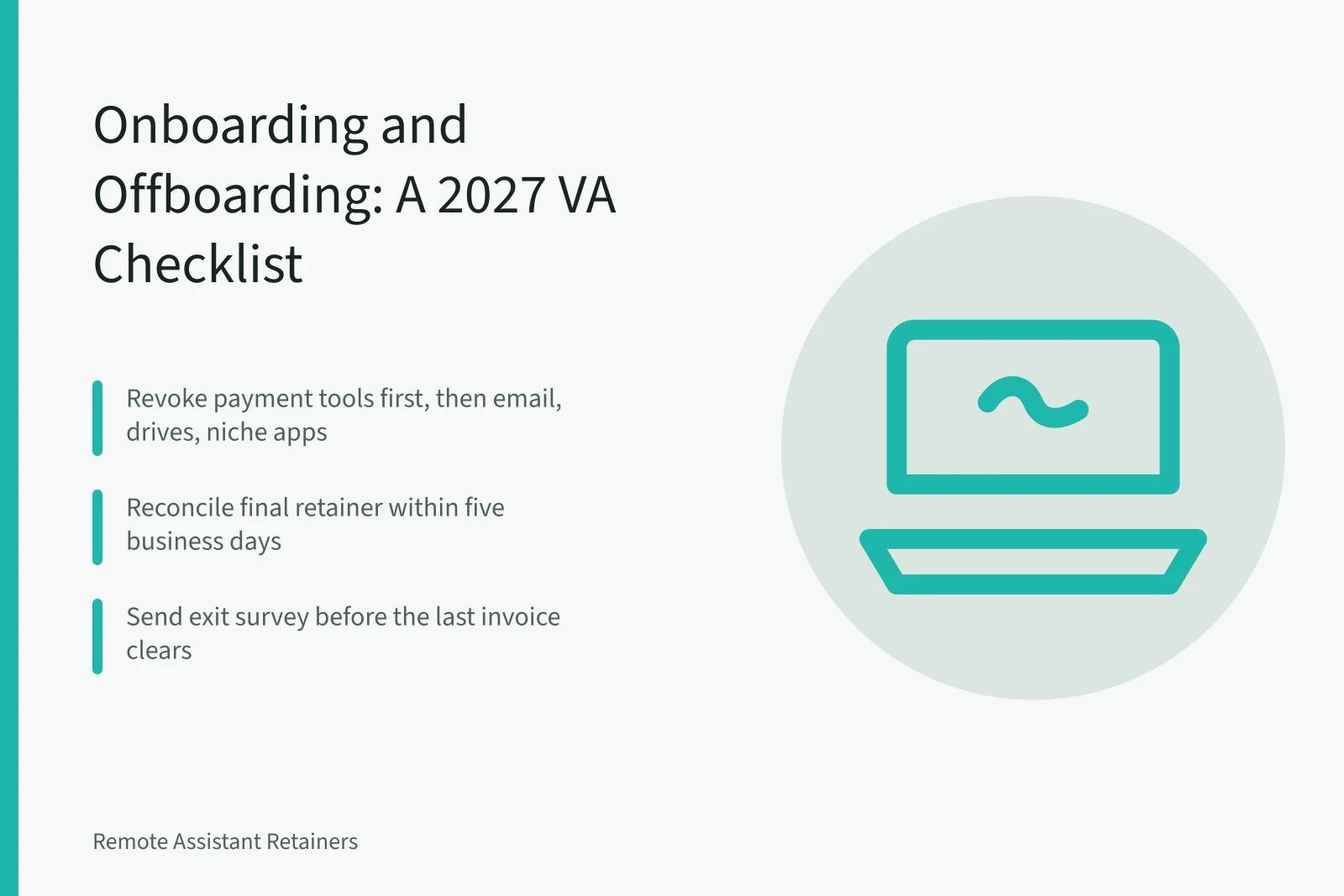
- Revoke access by risk tierpayment tools first, then email and calendar, then shared drives, then niche apps.
- Reconcile the final retainer within five business days and send the exit survey before the last invoice clears.
- A clean exit feeds the referral and renewal loops. It is the cheapest marketing an agency owns.
- Bilingual retainers in Austin and Miami add screening, tax, and coverage steps that change the exit plan.
Build the exit file at onboarding
Every offboarding step should have a matching onboarding step. If you collect a personal phone number, a home address, or a recovery email for two-factor codes, note where it lives and who can delete it.
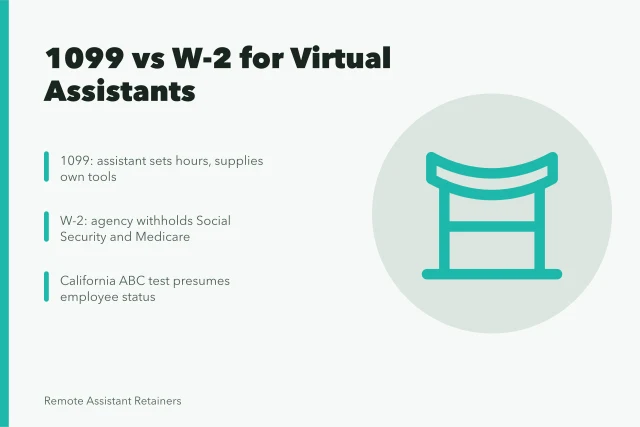
Classify each assistant correctly when you sign the engagement letter. The IRS test for IRS independent contractor test looks at behavioral, financial, and relationship factors. Mixing employee-style scheduling with contractor paperwork creates a tax problem at exit as well as at hire.
Bilingual retainers need a language screen on day one, not on the last week. Agencies that win bilingual retainer clients in Austin and Miami match screening, time-zone coverage, and pricing to each metro.
Write the language requirement into the scope line so the offboarding summary can confirm it.
Revoke access in a fixed order
Use the same order every time so nothing gets missed on a rushed Friday.
- Payment processor, banking, and payroll seats
- Primary email, calendar, and phone delegation
- Shared drives, project boards, and document templates
- CRM, dialer, scheduling, and industry apps
- Password manager vault entries and shared notes
Document what data the assistant touched. California's CCPA compliance obligations page explains data inventory and mapping duties. That inventory makes revocation checkable and gives you a record if a client asks later.
Final retainer reconciliation
Onboarding action
- Scope
- Sign the retainer and the task list
- Access
- Issue accounts and vault entries
- Billing
- Set invoice date and payment terms
- Data
- Map client files and personal data
- Feedback
- Set the 30-day check-in
Offboarding action
- Scope
- Confirm last deliverable date in writing
- Access
- Revoke and confirm within one business day
- Billing
- Reconcile hours, credits, and final invoice
- Data
- Return or delete files and log the action
- Feedback
- Send exit survey and hold exit call
The mirror matters because the final invoice often lands before access is gone. If the client owes for overage hours, say so in the same email as the revocation notice.
Example: a two week handover
Two week handover
- Day onefreeze new tasks, tell the client the end date, and name the internal owner.
- Day threesend the last deliverable list and an hours log for the final retainer.
- Day fivehold the exit call and send the exit survey.
- Day tenrevoke access and send written confirmation.
- Day fourteenissue the final invoice and archive the client file.
This schedule fits a solo assistant and a small pod. It also gives the client time to ask for a renewal or a referral before the file closes.
The exit interview and survey
Keep the survey short and repeatable. The client satisfaction survey questions that work best ask about communication, task quality, and whether the client would refer you. Add one offboarding-only question: what would have made you stay?
Ask the buyer, not the assistant, for the exit interview. The assistant may still be job hunting, and the buyer owns the renewal decision.
Renewal and referral loops
A clean exit gives you three assets: a written record, a survey score, and a reason to check in at 90 days. Those assets feed the virtual assistant agency trends that shape demand, especially the shift toward specialist retainers.
If your agency subcontracts work to other firms, the exit file gets more complex. Compare your options against white label services before you promise a client a managed handover. The SBA guide on market research and competitive analysis covers how to size that decision.