Guides
7 things worth knowing about virtual assistant agency trends
Seven shifts worth knowing in virtual assistant agency demand, and how each one shows up in your own pipeline before it changes what you sell.
What to take away
- Seven virtual assistant agency trends are named below, each with the pipeline evidence that confirms it in your market.
- Every one of them changes a line, a window, a price or a hire. None of them changes your positioning.
- Your last two quarters of discovery notes test any of the seven faster than a survey of intentions can.
- Labor cost and worker classification do not move with demand. Check those first when a trend argument gets loud.
- The tool stacks buyers name most often are Google Workspace, Microsoft 365, Slack, Notion, Asana, ClickUp and HubSpot.
- Run the test quarterly. Two quarters of movement in the same direction is worth acting on; one is noise.
1. Buyers want a named person, not a pool: Prialto, Boldly, Athena
The shift runs from a team of assistants to a named person: here is who works with you, and here is who covers their leave. Buyers now ask for that on the first call.
Agencies built on the promise include Prialto, which pairs each client with a dedicated assistant plus a backup, and Boldly, which markets assistants who work in the client's own time zone. Athena places executive assistants with founders on a monthly subscription. Time etc sells blocks of assistant hours in the same style.
It is on the list because it changes how you sell and how you staff. A named-person offer needs a named backup, which turns your bench into a cost line rather than a comfort.
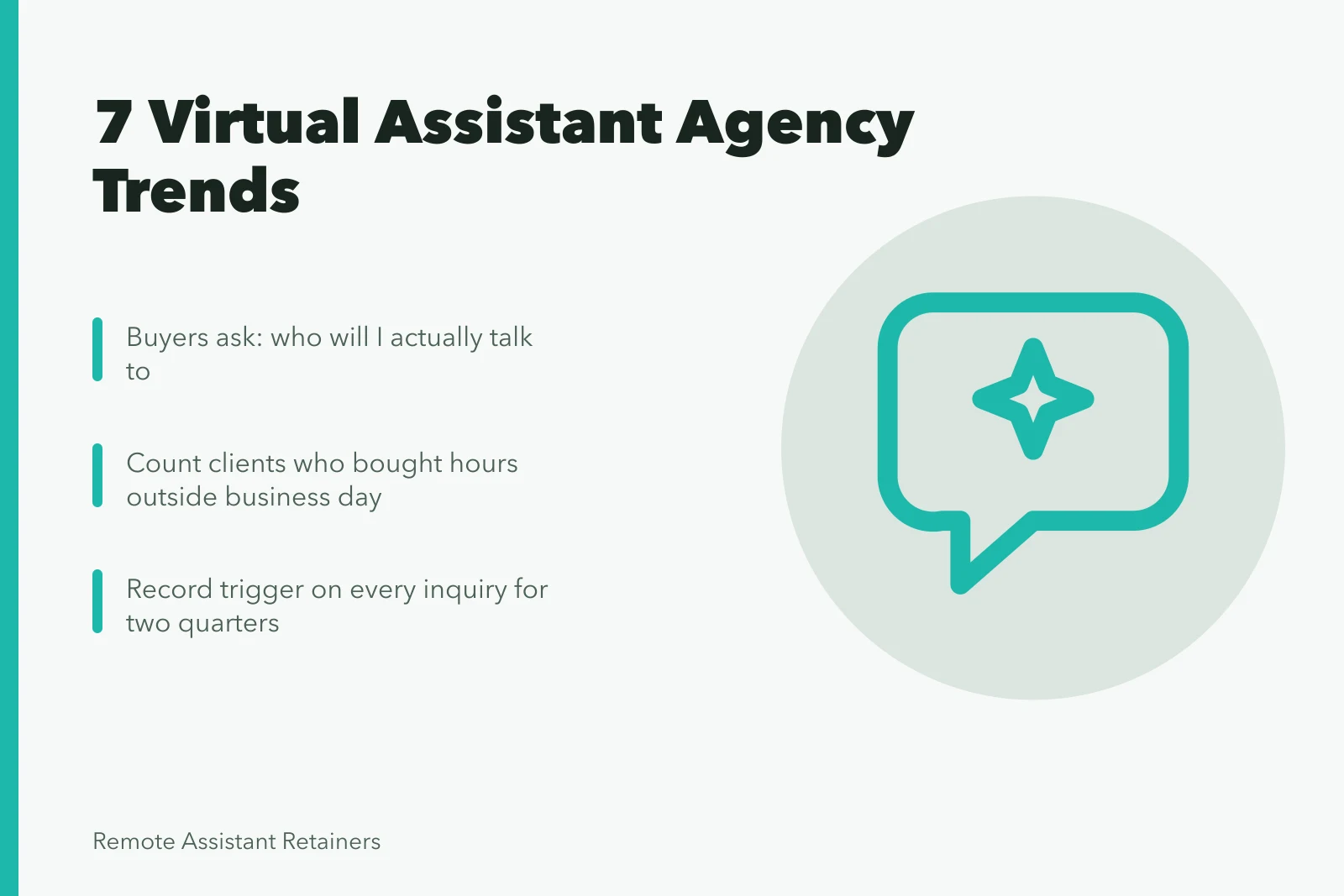
Find it in your pipeline by counting how many discovery calls included the words "who will I actually talk to." If that question shows up in most calls, the shift is already in your market.
2. Coverage windows are widening past business hours: Colombia, Argentina, Manila
Buyers increasingly ask for a block of hours that does not sit inside 9 to 5 in their time zone. Time-zone tiering answers that without paying an overnight premium.
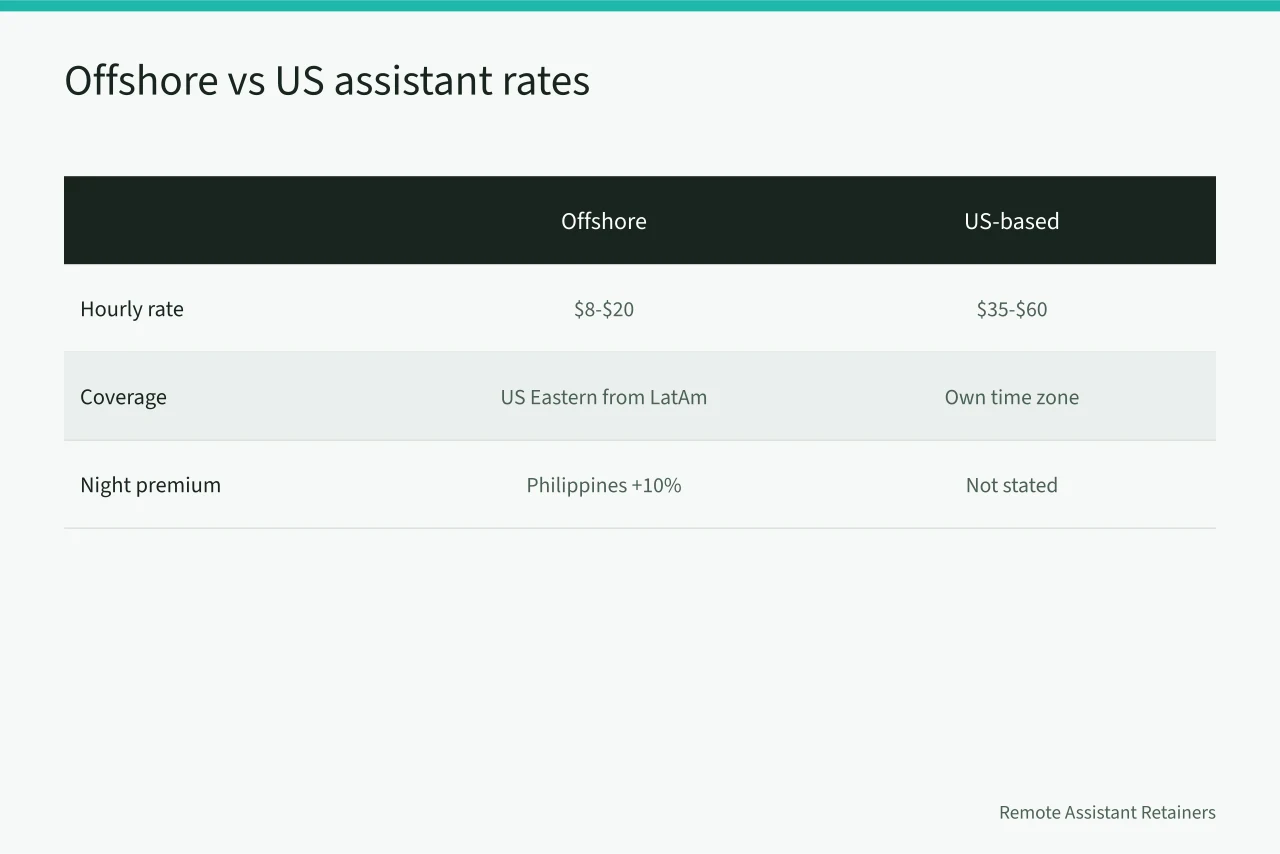
A second tier usually covers US Eastern hours from Colombia, Argentina or Brazil, where 9 a.m. in New York falls inside the local working day.
Philippine labor law requires a night shift differential of at least 10 percent of the regular wage for work between 10 p.m. and 6 a.m. India and South Africa cover UK and European mornings. Typical billed rates run from about $8 to $20 an hour offshore against $35 to $60 for US-based assistants.
It is on the list because it is the one trend that changes your hiring geography rather than your service menu. A second time-zone tier is a real decision, not a marketing line.
Check it against delivered work, not requests. Count how many clients actually bought hours outside their own business day. Interest is cheap here; the request is easy to make and easy to abandon.
3. Retainers are being priced as blocks, not hours: Harvest and Toggl Track
The shift runs from an hourly rate to a monthly block with a stated overage rule. Buyers compare blocks more easily than rates, and blocks make your own capacity planning possible.
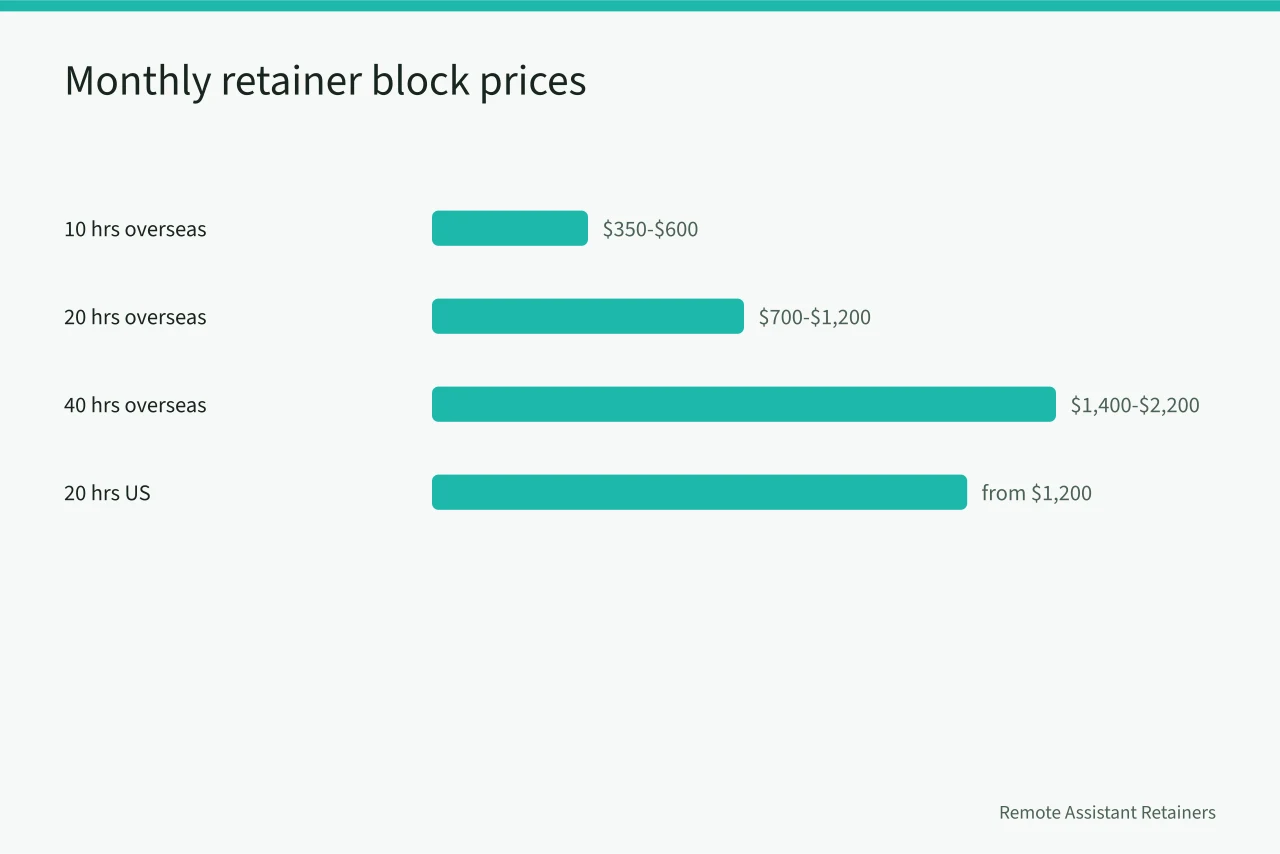
Common blocks are 10, 20 and 40 hours a month. Overseas teams typically publish about $350 to $600 for 10 hours, $700 to $1,200 for 20 and $1,400 to $2,200 for 40; US-based assistants often start near $1,200 for 20 hours.
Track hours in Harvest at $12 per seat per month or Toggl Track at $9 per seat per month, so the overage line has data behind it.
It is on the list because it is the trend most likely to be real for you and most likely to be done badly. An overage rule that nobody enforces turns a block into unlimited hours at a fixed price.
The mechanics of setting the block, the floor and the overage belong in the guide to agency pricing examples and quote structure, which shows the quote template alongside the arithmetic.
4. Buyers arrive with a trigger, not a category: quits, freezes, new systems
Nobody wakes up wanting a virtual assistant. They wake up after a departure, a hiring freeze, a busy season, or a new system that nobody has time to run.
The triggers show in public data before they show in your inbox. The BLS Job Openings and Labor Turnover Survey reports quits, hires and openings by month and industry, and a rising quit rate in a sector usually precedes replacement work there. A new Shopify or HubSpot rollout creates admin work the same way.
It is on the list because it is the most useful of the seven and the least discussed. Trigger changes are the real trends, and they appear in discovery notes months before they appear in any published survey.
Record the trigger on every inquiry. After two quarters you will have a distribution, and that distribution tells you what to publish and when to publish it.
5. Scope drift is being formalized: the change-order log
Clients keep asking for small things outside the agreed scope. Agencies now write a rule for it instead of absorbing it.
The common form is a change-order log with an hourly rate attached, kept in the project tool the client already sees, such as Asana or ClickUp. Out-of-scope requests get quoted on the next invoice rather than swallowed, and the log gets reviewed quarterly.
It is on the list because drift is demand you are already receiving, and it is the cheapest trend data available to you. Every out-of-scope request is a buyer telling you what they would pay for.
The practice of logging it, pricing it and reviewing it quarterly is set out in the pricing and profit guide.
6. Buyers ask what happens when the assistant leaves: Scribe, Loom, Notion
Continuity questions are moving from the end of the sales conversation to the start of it. Buyers want to know who holds the process knowledge and how it transfers.
The answer is a written process file per client, built where the client can see it. Scribe turns a sequence of clicks into a step guide, Loom records a walkthrough for roughly $15 per creator per month on its Business plan, and Notion or Google Docs holds the written version.
It is on the list because it changes your onboarding, not your pitch. If the answer is that the process lives in the assistant's head, you are selling a retention risk to the client.
Answer it with a documented handover: a written process file per client, reviewed on a schedule. The sequence for building that belongs in the hiring and training guide.
7. Buyers want the tool stack named: Google Workspace, Slack, HubSpot
More inquiries now include a question about which systems you work in. Buyers have already chosen their stack and do not want to migrate for you.
The stacks buyers name most often carry published prices anyone can check. Google Workspace Business Starter lists near $7 per user per month, Microsoft 365 Business Basic at $6, Slack Pro at about $7.25 billed annually, Notion Plus at $10 per member and Asana Starter at $10.99.
ClickUp Unlimited runs $7 per member per month and HubSpot Starter $15 per seat, with QuickBooks Online or Xero on the accounting side and Calendly at $10 per seat for scheduling. List rates move, so check the vendor page before you quote one back.
It is on the list because it is a qualification filter working in your favor. Naming the tools you support lets the wrong-fit buyer leave before the discovery call, which saves both sides an hour.
Publish the list. Update it when you add a system, and say plainly which ones you do not support.
The four-step test for any of the seven
| Step | What you do | What failure looks like |
|---|---|---|
| State it falsifiably | Rewrite the claim so it could turn out wrong | It cannot be written that way, so it is a mood |
| Find it in the pipeline | Search two quarters of inquiries and discovery notes | Nobody asked for it, in any words |
| Check delivered work | Look for people who bought, not people who asked | Interest without a single purchase |
| Decide what changes | Name the line, window, price or hire it affects | The only answer is your positioning |
Most claims die at step two, and that is the step working correctly. A shift nobody in your pipeline has mentioned is a shift affecting somebody else's market.
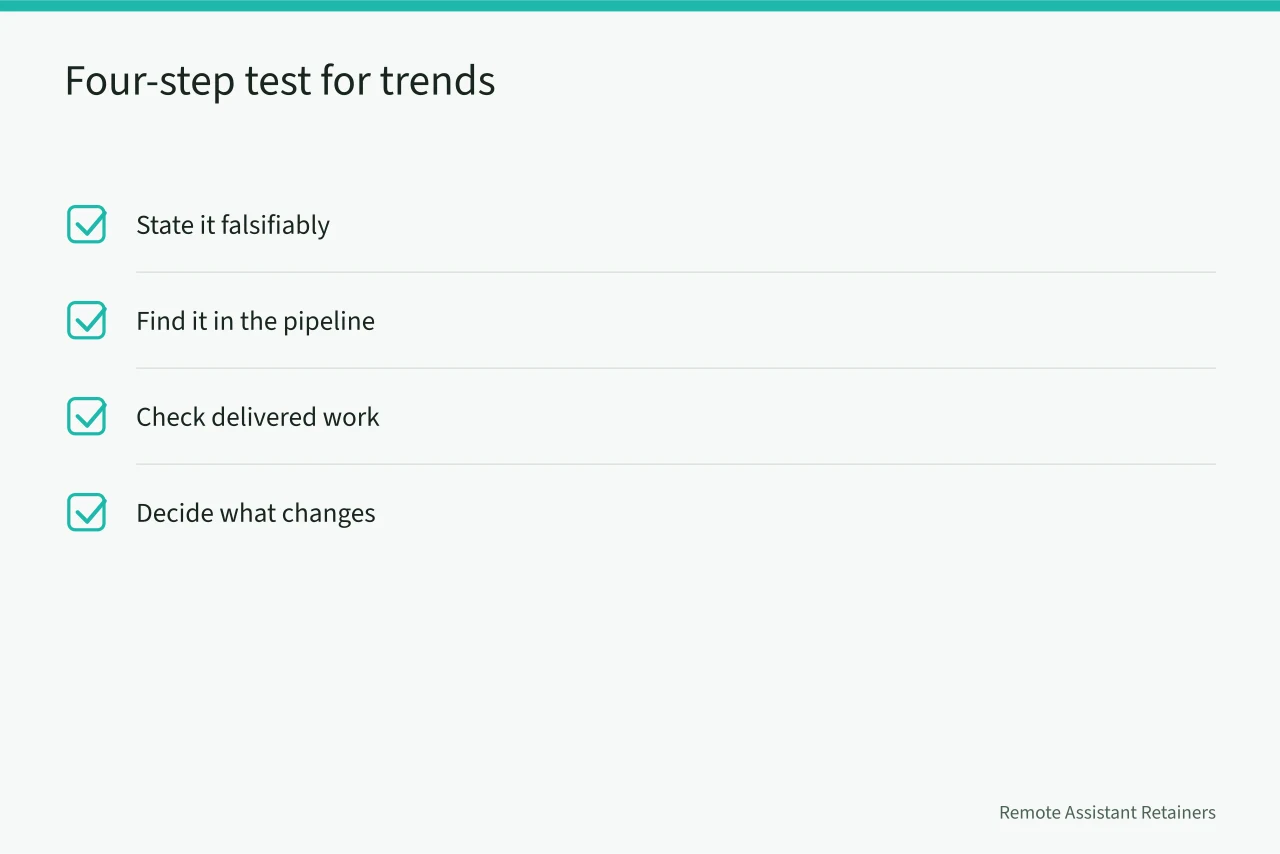
Step one is harder than it reads. "Buyers want more flexibility" cannot be tested. "Buyers in our market will ask for coverage outside their own business hours" can be.
Step two uses the record you already keep. Go through your last two quarters of inquiries and discovery notes and count how many mentioned the thing, and in what words.
Step three separates requests from commitments. If buyers asked and nobody bought, you have found an interest rather than a demand.
Step four has to name something concrete: a service line, a coverage window, a price structure, a hiring plan. If the answer is your positioning, the test has not finished.
Responding without repositioning
When a shift survives all four steps, the response is usually small.
Run one experiment with three things written down in advance: what you will offer, to whom, and what result would make you stop. Give it a defined period. Compare the result to your starting position rather than to the hope.
The stop rule matters because an experiment without one becomes a commitment by default. Agencies rarely abandon a new service line; they carry it for years, delivering it to one client, at a cost nobody has measured.
Where the experiment is a genuine change of direction rather than an added line, the readiness questions belong in how you price and staff it, which follows the method in the sales and proposal guide.
The three constraints that do not move
Whatever happens to demand, three things stay true, and they are worth holding onto when a trend argument gets loud.
People cost what the labor market says they cost. The BLS occupational employment and wage statistics tables publish employment and wage estimates by occupation, industry, state and metropolitan area. They will tell you more about your cost base next year than any demand forecast will.
Worker status follows the arrangement. Any shift toward more flexible or more distributed staffing runs into the same analysis. The Labor Department's page on misclassification myths makes the economic reality of the relationship decisive rather than the label on an agreement. Classification rules vary by state, so confirm your own arrangements with a licensed employment attorney.
The regulatory and registration layers around a business do not move with fashion. The SBA business guide maps them, and a new service line does not exempt you from any of it. Registration and tax treatment vary by state; your state revenue department and a licensed CPA are the authorities for your jurisdiction.
An agency that keeps those three straight can afford to be wrong about a trend. One that has restructured around a forecast cannot.
Staffing against a trend you are not sure about
Do not hire against a forecast. Hire against sold work with start dates, or against a supervision load that has stopped falling.
Where a possible shift needs a capability you do not have, train an existing person rather than recruiting a specialist. Training is reversible; a specialist hire with no volume behind them is idle capacity you are paying for. Contractor payment tools such as Gusto, at about $6 per contractor per month, keep the paperwork separate from the hire.
Keep the cost per delivered hour in view throughout, because its components are what any expansion actually consumes. The breakdown sits in the guide to agency pay rates and labor costs.
Common questions
Should I ignore published trend surveys entirely?
No. Read them for the questions they raise, then test those questions against your own pipeline. Treat the conclusions as hypotheses rather than findings.
What if a competitor has moved on a trend and I have not?
Find out whether they are selling it or only advertising it. Those are different, and the second is far more common.
How often should I run this test?
Quarterly, on whichever of the seven you have heard most often. It takes an hour if your discovery notes exist.
What if my pipeline is too small to see anything?
Then say so and act on judgment rather than pretending the data supports you. Acknowledging a thin sample is more useful than a conclusion drawn from six conversations.